
How Does a Real Estate Agent Take Time Off?

Planning Ahead So You Can Actually Unplug
They say the best way to learn to do something is to teach it, right? I say that in jest, but do I? Selling real estate is one of those things that waits for no one. Deadlines, client care, marketing, posting, and responding to questions all feel time sensitive, and together they can make real estate feel like a 24 hour emergency room.
If I am being honest, some things really are incredibly time sensitive. But some are not. They just feel like it. After more than 22 years in this business, I have learned that the difference between the two is where a good vacation plan lives. Let's talk about it.
In This Post
1. What Is Actually Time Sensitive?
2. Start With a One-Page Coverage Document
3. Tell Your Clients Before You Leave
4. Put Every Deadline on Your Calendar
5. Pre-Plan Your Posts
6. Give Email a Folder
7. Keep a Running Note to Self
8. Clear Your Calendar Before You Go
9. Check Your Internet Before You Leave
10. Practice Makes This Easier
11. Frequently Asked Questions
12. Related Reading
What Is Actually Time Sensitive?
Here is the question I ask myself before any time away. If I do not touch this for a week, what actually breaks?
Contract deadlines break things. A buyer who found a house they love and wants to see it before someone else does is time sensitive. An inspection remedy request that has a clock on it is time sensitive. A new lead who needs a reply is time sensitive, although someone else can cover that.
A post that did not go out on Tuesday is not time sensitive. An email from a vendor about next month is not time sensitive. A networking coffee can wait. Once you sort your list into those two piles, the plan gets much smaller than you thought it would be.
The rest of this post is the system I use. Take what you can use and leave the rest.
Start With a One-Page Coverage Document
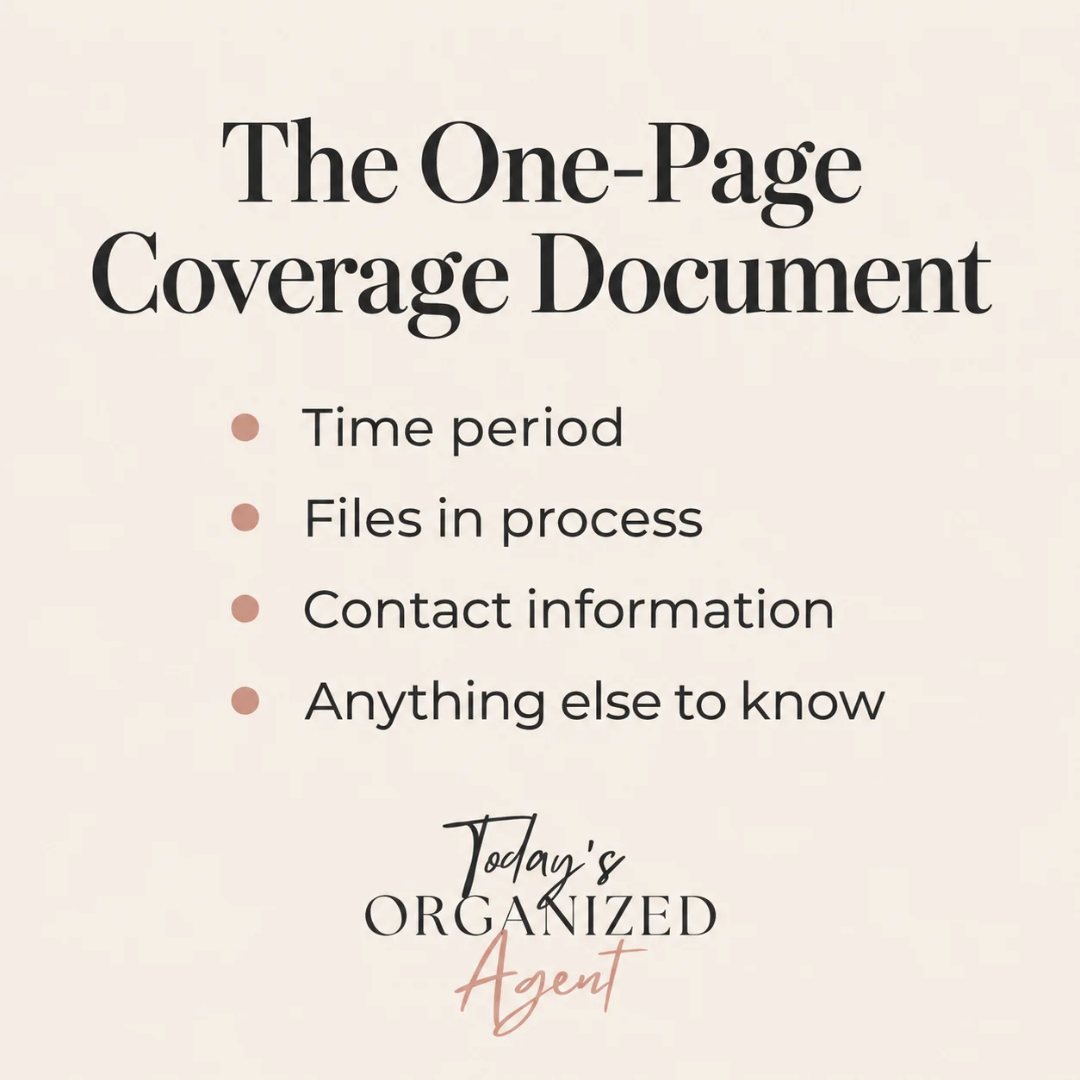
If you have someone covering for you, type up a one-page document. One page is the goal because no one reads five. Here is what goes on it.
Time period. When you are leaving and when you return. Include the day you will start answering again, so no one wonders.
Files in process. List which files need attention while you are away. Be specific about what is coming up on each one, such as an inspection, an appraisal, or a closing date.
Contact information. Include yours and your clients'. Then start a group chat with your clients and your coverage agent. Name the group chat the file address so everyone knows what it is about when it pops up on their phone. Explain your absence in the first message and share the contact details there.
Anything else the covering agent needs to know. This is the place for the small things. Maybe a seller likes a text instead of a call. Maybe a buyer is nervous and needs a quick reply. Maybe the lockbox code is tricky. You know these details, and your coverage agent does not.
When the page is done, send it to your coverage agent a few days early, not the night before. Give them time to ask questions.
Tell Your Clients Before You Leave
Let your clients know you will be away, and assure them that you have it handled. This matters most for your buyers. Let them know they should still contact you when they find a house they want to see. Then introduce the agent who is covering for you.
This is where the group chat earns its keep. Your client sees the name of the person who will help them. Your coverage agent sees the whole picture. You stay in the loop without being buried. It is a wonderful system for keeping you up to date, and it gets your client what they need without waiting for you.
I have found that clients are far more relaxed than we expect. They do not need you to be available every minute. They need to know someone competent has the file.
Put Every Deadline on Your Calendar
Deadlines are time sensitive, and every good plan starts with a system. Here is mine.
I add all of my contract deadlines to my calendar as appointments. Technically, my robot does it. Each new in-contract file has deadlines, and those get sent to the client and added to my calendar automatically. That means I am never relying on my memory.
Every morning on vacation, I review my calendar. It takes a few minutes. I take care of any inspection remedy requests first, because you cannot miss those deadlines. After that I look at what else is coming up in the next few days, and then I close the app.
If you do not have a system that puts deadlines on your calendar for you, build one before you leave. Entering them by hand works too. What matters is that every date lives in one place that you will actually look at.

Pre-Plan Your Posts
I use Publer to schedule my content so the machine keeps moving while I am away. Please do not lose your momentum online. It is hard to rebuild.
If you do not have Publer, that is fine. Create your posts ahead of time and use the schedule tool inside Facebook, LinkedIn, and the other platforms you use. It is like magic. You sit down for one working session, and then your content goes out all week without you.
A good rule is to schedule one extra week beyond what you need. Travel gets delayed. Things happen. A little cushion keeps you from scrambling.
Give Email a Folder
Start a folder in your inbox where you can drop important but not urgent emails. Respond as time allows, or when you get back. Try not to live in your email during vacation. Note that I said try.
The folder works because it takes the decision out of the moment. You read an email, you decide it is not urgent, and you move it. You are not stewing over it at dinner. Anything truly urgent will come from your coverage agent, your client, or a phone call, and those you will see.
Keep a Running Note to Self
Keep a running note in your phone for things that pop up that you want to address when you get back. A new idea for a listing presentation. A follow-up you just remembered. A question you want to ask your title rep.
This takes it out of your brain so you can relax. Your mind stops holding on to it because you know it is saved somewhere. When you come back, the note becomes your first-day plan.
Clear Your Calendar Before You Go
Start a few weeks before your time off and begin scheduling things out. What I mean is, do not book yourself on purpose while you are away. Mark your vacation in your calendar so that when the phone rings, you have a clear idea that you will be gone.
It sounds obvious, but I see agents do this to themselves all the time. A client asks for Thursday at 2:00 and you say yes without checking, and now you are rearranging a trip. Block the dates early so your calendar answers for you. Networking can wait.
Check Your Internet Before You Leave
Make sure you will have a good connection, a hot spot, and enough data. All the things. Even on a cruise ship, you can secure the internet package. Use Wi-Fi calling. Call your phone provider and ask about a data package for your location. Many providers offer international plans at little to no cost.
You do not have to be online all day. You just need to know that if you have to check a deadline or answer a call from your coverage agent, you can. Plan ahead and test it before you board the plane.
Practice Makes This Easier
I know I am making this sound simple during a time when you may feel anything but simplified. It does take practice. Put the time in before you leave to think through what may come up. It is time well spent.
I have gone years without taking a true break, and I do not recommend that to anyone. Try not to be me. We all need a break, and the business will still be here when you get back, especially when you have a plan that holds it steady.
If you want to talk through your own plan with other agents, join me at the free Wednesday Agent Collaboration for Realtors. You can register at todaysorganizedagent.com/collaboration
Frequently Asked Questions
How far in advance should I start planning time off as a real estate agent?
I start two to three weeks before I leave. That gives me time to write the coverage document, set up the group chats, schedule my posts, and block my calendar. If you are newer to this, give yourself even more time for the first trip.
What should go in a coverage document for another agent?
Keep it to one page. Include the dates you are away, the files in process and what each one needs, the contact information for you and your clients, and anything else the agent should know, such as how a client likes to be reached.
Do I need to check my calendar every day while I am away?
Yes, I do. A quick morning review of contract deadlines keeps you safe. Handle anything time sensitive first, like inspection remedy requests, and then put your phone down.
How do I keep my social media going while I am on vacation?
Schedule it ahead. A tool like Publer works well, and the scheduling tools inside Facebook and LinkedIn do the job too. Sit down for one session before you leave and queue up everything you need.
Will my clients be upset if I take time off?
In my experience, no. Most clients care that someone is handling their file and that they know who to call. Tell them early, introduce your coverage agent, and let them know they can still reach out when they find a house they want to see.
What if I cannot fully unplug?
That is common, and it is okay. The goal is not to be unreachable. The goal is to be reachable only for what is truly urgent. Use an email folder, a running note, and a short daily calendar review, and let everything else wait.
Related Reading
If you want to take even more off your plate, I also have the Objection Handler Cheat Sheet and the 45 AI prompts in the AI Prompt Library. You can find them at todaysorganizedagent.com