
Buyer Leads Set For Success
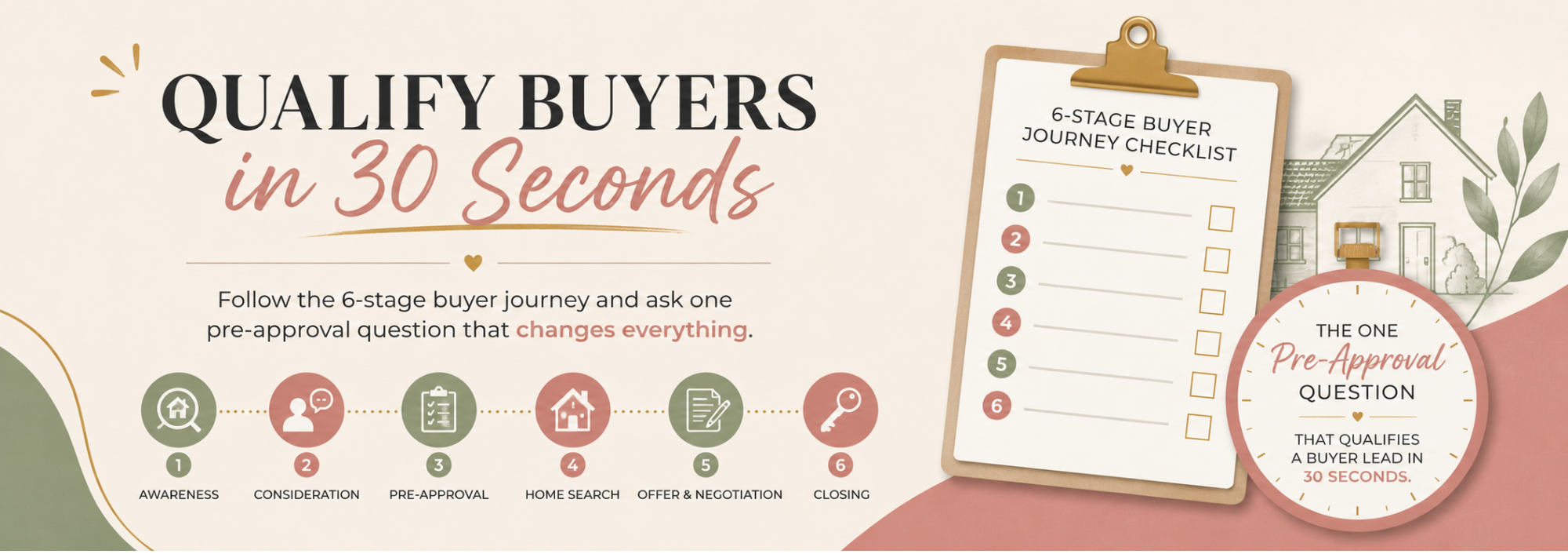
Follow the 6-stage buyer journey and ask one pre-approval question that changes everything.
The Buyer Journey Checklist That Finally Made Me Feel Like a Professional, Not Just Lucky
The Buyer Journey Checklist That Finally Made Me Feel Like a Professional, Not Just Lucky
I am older than Google. I sold my first house with a fax machine and a prayer. So when I tell you I still use a written checklist for every single buyer, twenty-one years in, I need you to know that is not me being new at this. It is me being honest about what actually works.
A REAL STORY
Several years ago I had two buyers going at the same time. One was a young couple buying their first home, nervous about everything, texting me at all hours with questions about earnest money and inspection timelines. The other was a relocation client, calm, organized, mostly hands off, the kind of buyer who made you feel like the whole process was easy.
I was juggling both in my head. No list, just vibes and memory, the way I had done it for years, and honestly, the way most of us are trained to do it. Nobody hands you a checklist when you get your license. They hand you a stack of forms and tell you to figure out the rest.
The relocation client went quiet under contract for about ten days. Nothing was actually wrong, we were just between steps, waiting on an appraisal to come back. But I never called to check in, because in my head, quiet meant fine. It was not fine, at least not to her. She called her lender directly, panicked, thought something had fallen through. Nothing had. I just never told her where things stood, because I didn't have anything written down telling me I needed to.
That phone call from her lender, relaying her panic back to me, was the moment I stopped trusting my memory to run my business. Not because I forgot something important. Because I realized how easy it is to let silence do damage even when nothing has actually gone wrong.
THE PROBLEM
Most of us are genuinely good with buyers. We show up, we're warm, we know the market, we can spot a good deal from a bad one in about four seconds. The breakdown almost never happens in the parts everyone worries about, the showings, the negotiations, the parts that feel like the real estate agent job.
It happens in the handoffs between stages. The quiet in-between moments where nobody said anything was wrong, but nobody said anything was right either. Your buyer doesn't know the difference between normal waiting and something going sideways. All they know is they haven't heard from you.
When you have a process, you show up the same way every time, whether it's your first buyer of the year or your thirtieth. Whether you're having a great week or a week where everything is falling apart around you personally. Without a process, you're relying entirely on how much energy and attention you happen to have that particular week, and buyers can absolutely feel the difference, even if they can't name what's different.
And here's the part that costs you money down the road. A buyer who felt a little lost during their transaction, even if everything technically closed fine, is a buyer who is far less likely to refer you to their sister, their coworker, their neighbor. They won't necessarily complain. They'll just quietly not think of you when someone asks if they know a good agent. Consistency is not just about the current transaction. It's about every transaction that comes after it, the ones you never see coming from a referral you never got.
WHY THIS HAPPENS
We don't build checklists because we think we don't need them. Most of us know, somewhere in the back of our minds, that we should have one. We skip building it because building one feels like one more task on a day that's already full of showings and calls and paperwork. So we keep it in our heads instead, and our heads are already busy holding twelve other things, plus the name of the inspector we need to call and whether the Wilsons signed their disclosure yet.
Here's the shape I finally landed on, after years of almost building this and never finishing it. Six stages, start to finish.
Stage 1, First Contact. This is where I ask the one question that changes everything, and I mean everything. Before I search for a single listing, I ask: have you spoken to a lender yet to get pre-approved? Some homes qualify for FHA, some don't. Some are conventional only. A few are USDA approved. So which type will you be using? Once I know that, I can actually begin the search instead of showing someone six houses they can't actually buy.
Stage 2, Buyer Consultation. This is where we sit down, in person or on a call, and I walk through what actually matters to them, not what I assume matters to them based on the last three buyers I worked with. Every buyer is different, and this stage is where you find out how.
Stage 3, The Search. Showings, feedback, adjusting the search based on what they liked and didn't like. This stage mostly runs itself once the first two stages are done right, which is honestly a relief, because this is the stage that eats the most calendar time.
Stage 4, Offer and Negotiation. I keep an offer checklist ready before I ever need it. Contingencies, timelines, earnest money amounts, all of it thought through ahead of time, not scrambled together while I'm on the phone with an excited buyer who just found their house.
Stage 5, Under Contract. This is the stage that gets everyone, including me that one time. Every step here needs a date and an owner. Appraisal ordered, by when. Inspection scheduled, by when. Repairs negotiated, by when. If a buyer goes ten days without hearing from you during this stage, they will assume the worst, even when everything is completely fine on your end.
Stage 6, Closing and Beyond. The thank you note. The referral ask. The little check in a few months later just to see how they're settling in. Not optional, just easy to forget when you're already three buyers into the next thing.
TYPE THIS INTO YOUR CHAT BOX
Here's where AI actually earns its keep. Not writing your whole business for you, not replacing the relationship, just handling the small communication tasks that pile up during Stage 5, the exact stage where agents tend to go quiet without meaning to.
Try this prompt exactly as written, just swap in your buyer's actual situation:
"Write a quick email to my buyer letting them know I'm still actively watching the process for them. There's nothing new right now but I want them to know I haven't gone quiet. Keep it warm and brief."
That's it. Thirty seconds, and your buyer hears from you instead of wondering. You can use a version of this same prompt at every stage where you'd normally go quiet, just change the situation you're describing. The point is not to let AI decide what to say. The point is to make sure something gets said at all, on the days you have twelve other things pulling at you.
HERE'S SOMETHING I NOTICED
The agents who feel the most consistent to their clients are rarely the most naturally charming ones. I've watched plenty of agents who could charm a room walk away from a transaction with a client who felt completely lost the whole time. The agents who feel consistent are the most prepared ones.
A checklist doesn't replace warmth, it actually protects it. When you're not burning mental energy trying to remember what comes next, you get to spend that energy actually being present with the person in front of you. That's the part that surprised me most when I finally built mine. I didn't become less warm with my buyers. I became more present, because I wasn't distracted trying to remember what I'd forgotten.
There's a version of this that shows up outside of real estate too. Think of any professional you've ever trusted immediately, a doctor, a mechanic, a good hairstylist. Chances are it wasn't their charisma that earned your trust. It was the sense that they knew exactly what came next, every single time you saw them. That's what a checklist gives your buyers, whether they could ever name it or not.
TRY THIS TODAY
You don't need to build all six stages today. Pick just one, the one that gives you the most trouble. For a lot of agents it's Stage 5, under contract, the quiet stage where things feel handled but nobody's telling the client that.
Write down every single step that happens during that one stage, and next to each one, put a date and a name, even if the name is just you. Appraisal ordered, three days after acceptance, you. Appraisal received, follow up if not received within ten days, you. Inspection scheduled, within five days, you.
That's the whole exercise. One stage. One list. You can build the rest of the stages later, once this one is running on its own. Don't wait until you have time to build all six perfectly. You won't find that time. Build the one that's costing you the most sleep, and let it prove itself before you tackle the next one.
ONE LAST THOUGHT
I didn't build this checklist because I stopped trusting myself. I built it because I got tired of hoping I'd remember everything on the hard weeks, not just the easy ones. Every agent has easy weeks and hard weeks. A checklist means your buyer gets the same version of you either way.
A checklist means you show up the same way for every buyer, the nervous first timer texting you at midnight and the calm relocation client alike, whether it's your first close of the year or your fortieth. That consistency is not a personality trait. It's a system. And systems, unlike memory, don't have bad days.
Twenty-one years in, I still learn this lesson over and over. The agents I admire most in this business aren't the ones who never drop anything. They're the ones who built something sturdy enough that dropping one thing doesn't take the whole transaction down with it. That's all a checklist really is. Something sturdy enough to hold you up on the days you don't have much left to give.
If you want more helpful AI tips, download my free mini eBook on my website, under products! https://www.todaysorganizedagent.com/products