
The Listing Side, Systemized
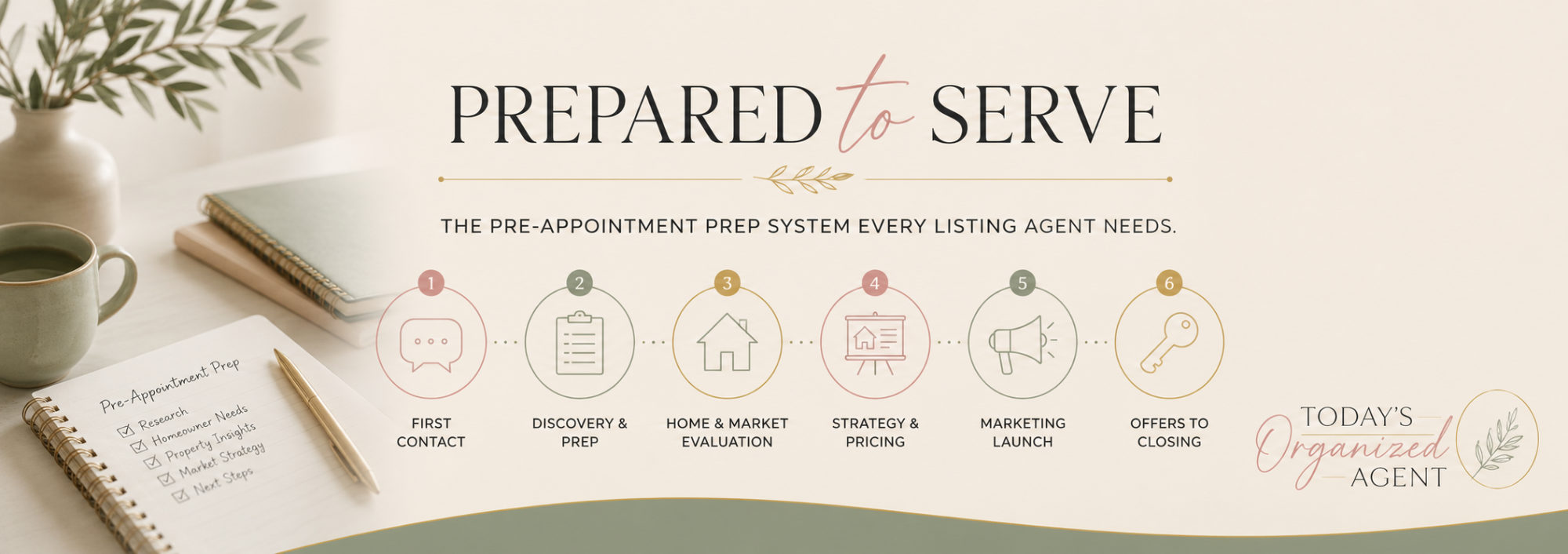
I've been a Realtor for over twenty-one years, and I still remember the first listing appointment I ever won. I also remember the first one I lost, and I lost it because I walked in without pulling all the comps. The seller could tell. She asked me a simple question about a home two streets over that had sold the month before, and I didn't have the answers. She hired someone else.
That was a long time ago, but I think about it often, because it taught me something that took me years to fully believe. The difference between winning a listing appointment and losing one usually isn't confidence, and it isn't experience alone. It's whether you walked in prepared. I built a system for the listing side of this business a while back, and I use it every single time now, whether it's my first listing of the year or my thirtieth.
This week in our Wednesday Zoom class, we walk through the whole listing side of the business, start to finish. Six stages. Pre-appointment prep, the listing presentation, getting the home market-ready, active marketing, under contract, and closing and beyond. If you've never mapped it out that way before, you might be surprised how much actually happens before you ever sit down at a seller's kitchen table.
Why Pre-Appointment Prep Is Where the Money Gets Left on the Table
Most agents, myself included for a long time, put nearly all their energy into the listing presentation itself. We rehearse what we're going to say. We print out a nice folder. We show up looking sharp and ready to talk.
But here's what I've learned the hard way, slowly, over a lot of appointments. The presentation is the easy part if the prep work underneath it is already done. And the prep work is exactly the part most of us skip, because it feels less urgent than getting dressed and driving over to the seller's house.
Before I ever knock on a seller's door now, there's a whole sequence that happens first, and it's a lot more than pulling a few numbers.
It starts before the appointment is even confirmed. I confirm the date and time, and I come to the table with three proposed price points, not one number I'm hoping sticks, but a real range backed by research. I pull the comps, not just what's currently listed, but what actually sold recently and for how much. I look by map, subdivision, and auditor. I pour over the photos of every comp. I look at the property's own history too, when it was purchased, what's been done to it since, whether there's a prior listing on file, whether there are any liens or permits that are likely to come up later. And I get a net sheet from the title company ahead of time, so the seller sees real numbers, not estimates, when we talk about proceeds.
At the same time, there's a whole administrative side that happens in the background, the kind of thing that never makes it into a generic checklist. The lead gets logged into my systems, so nothing about this appointment lives only in my head. Whoever referred the seller gets a thank you letter, sent before I've even walked into the appointment, not after. The appointment goes on my calendar properly, not just as a mental note. I create an actual folder for this listing, digital, with subfolders for paperwork, texts, courier requests, photos, every buyer lead call, so that six weeks from now when someone asks a question, the answer is one click away instead of a memory I'm trying to reconstruct.
Then there's the paperwork itself. I start the transaction file and I put together a complete set of pre-printed listing documents, ready to go before I ever arrive. Even if your brokerage uses electronic signatures, be prepared and bring paper copies too. None of that gets assembled from scratch at the appointment. It's ready before I arrive.
And then there's the physical side of the appointment itself, which sounds almost silly to write down, except that showing up without it is exactly the kind of thing that makes an agent look unprepared. A small gift for the seller. Signs, ready to go in the yard the moment the agreement is signed. A camera with a charged battery and an empty card. Pens, business cards, a shoe cover basket by the door for anyone touring the home later. Small things, but every one of them is a thing you don't want to be missing in front of a seller who's watching how you operate.
All of that, and I haven't even sat down at the kitchen table yet.
After the appointment, the sequence isn't finished either. Every document gets scanned and filed properly. My systems get updated to reflect where things stand. And two calls or notes go out that most agents skip entirely, a thank you call to whoever referred the seller, and a thank you note to the seller for their time, whether they sign with me that day or not.
If you search listing checklist for real estate agents, you'll find plenty of generic templates online, and almost none of them capture this. Most jump straight to the presentation, the folder, the pricing strategy, as if that's where the work begins. But by the time I'm sitting across from a seller, the real work is already done. I'm not guessing at the number, I'm not caught off guard by anything in the property's history, and I have an actual, specific answer ready when they ask me something like "why is my house worth more than the one two streets over that just sold." Sellers ask that question far more often than you'd think, and having a real answer, backed by a real process, changes the whole tone of the appointment.
Stage Two: The Listing Presentation
Once the prep work is actually done, the appointment itself gets a lot easier, almost noticeably so. You're not performing confidence in front of the seller, you actually have it, because you know the numbers cold before you ever walk in.
I keep my presentation simple, on purpose. I walk the seller through the comps I pulled ahead of time, I explain my pricing recommendation and the reasoning behind it, and I'm honest with them about what I think the timeline will realistically look like given current market conditions. I don't oversell. I don't promise a number I can't back up just to win the listing, because that always comes back to bite both of us later. Sellers can tell the difference between genuine confidence and a sales pitch, even if they can't always name what they're sensing. Confidence wins more listings over time than charm ever will.
Stage Three: Getting the Home Market-Ready
This is the stage where a lot of us feel a little awkward, because it usually means having honest conversations about a home the seller loves, clutter, needed repairs, that one room that's been "temporary storage" for the last six years and has quietly become a catch-all.
I've found the easiest way through this stage is to frame it as math, not judgment. I'm not telling a seller their home isn't nice, or that their taste is wrong. I'm showing them, as specifically as I can, what buyers actually respond to when they walk through a door, and what that response is worth in real dollars at closing. A decluttered living room isn't a personal failing on the seller's part. It's a few thousand dollars of value sitting there for free, waiting to be picked up with an afternoon of work.
Stage Four: Active Marketing
Once the home is actually ready to show, this is where having a real system starts to pay off in a big way, because there's a lot happening at the same time, and it's easy for something to slip through the cracks if you're relying on memory alone.
Photos need to go up. The listing description needs to be written well, not just accurately, but in a way that actually sells the home's best features. It needs to get onto the right platforms, promoted the right way. Showings need to be coordinated around the seller's schedule. And every single agent who brings a buyer through needs a follow-up call, both for feedback and because that feedback is genuinely useful information for the seller.
I keep a simple running list for this whole stage so nothing slips through. Which platforms the listing is live on. Which showings have already happened and what feedback came back from each one. It doesn't need to be complicated or fancy. It just has to actually get looked at and updated every day, not built once at the start and then forgotten about for two weeks.
Stage Five: Under Contract
This stage is where both buyers and sellers tend to get anxious, and honestly, for good reason. There's a lot riding on it, and a lot of moving pieces happening at once that the seller usually can't see directly. Inspection. Appraisal. Repair negotiations. Financing contingencies that could fall through at almost any point.
The sellers I work with tell me they feel calmer during this stage when they know exactly what's happening and roughly when, even when the news isn't always what they were hoping to hear. A quiet week from your agent during this particular stage tends to feel like something's gone wrong behind the scenes, even when absolutely nothing has. A quick check-in message, even something as simple as "still on track, nothing new to report this week," genuinely goes a long way toward keeping a seller calm through the process.
Stage Six: Closing and Beyond
This is the stage most of us are honestly the worst about, myself included for a good chunk of my career. The deal closes, everyone breathes a sigh of relief, and then the agent quietly disappears from the seller's life. No thank you note. No real follow-up a few weeks later. No referral ask, even a soft one.
I don't say this to be hard on anyone, myself least of all, because I was exactly this agent for a long time before I changed anything. But it's worth naming plainly, because I think most of us know it deep down and just don't act on it: this stage is free goodwill sitting right there on the table, and most of us walk right past it, because we're already three steps ahead mentally, thinking about the next listing instead of closing this one out properly.
Why This Actually Matters More Than It Might Seem
None of these six stages are complicated on their own, and I want to be honest about that. There's no secret trick hiding in any of them. What actually makes the difference is having them written down somewhere concrete, so you're not relying purely on memory during a busy season when you have four listings going at once, and so that every single seller gets the same level of care from you whether it's your easiest year in this business or your hardest one.
That's really what "systemized" means to me, at the end of the day. It doesn't mean doing more work, and it definitely doesn't mean adding complexity for its own sake. It means doing the same good, careful work every time, consistently, without having to hold every last detail in your head while you're also running a full pipeline of other clients.
If you want to build out your own version of this system, come join us live on Wednesdays at 10AM EST. It's a free Zoom class, completely unpaid, and we walk through a different piece of the business each week together. Or if you'd rather get a head start on your own first, you can request the free mini guide on my website, and it walks through the basics at your own pace, whenever you have time for it.
I'm not going to pretend I had all of this figured out twenty-one years ago, because I very much did not. I learned most of it the slow way, one missed detail and one awkward follow-up phone call at a time. But that's really the whole point of writing it down and sharing it now, so that you don't necessarily have to learn every single piece of it the same long way I did.